
Pressing play loads the YouTube video. The narration is in Japanese. Watch on YouTube
- The foundation of Nine Star Ki is a table of numbers (the board) with 1 to 9 laid out in a 3×3 grid.
- In this table, all eight lines — rows, columns and diagonals — add up to 15.
- The numbers of the table are fixed as the numbers of nine places, and the stars that sit in those places are the nine stars (One White, Two Black … Nine Purple).
- The stars move one place each year in number order, and go all the way round in nine years. This year's board is found by lining the stars up in order, starting from the star in the centre.
- The same arrangement of numbers appears on a divination board from ancient China more than 2,000 years ago, and it was organised as “Kigaku” in Japan in the Taisho era.
To find which square your star is in this year, enter your date of birth in the Nine Star Ki Fortune Calculator (free, no sign-up).
01The foundation: the numbers 1 to 9 in a 3×3 table
The board used in Nine Star Ki puts each of the numbers 1 to 9 into one square of a 3×3 grid. From the top row down: “4 · 9 · 2”, “3 · 5 · 7” and “8 · 1 · 6”.
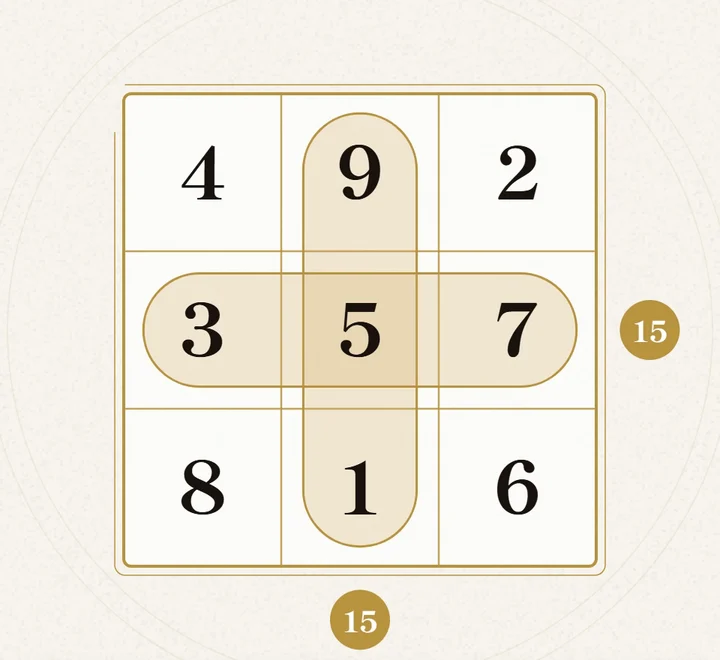
In ancient China this arrangement was called the Luo Shu. In mathematical terms, it is a magic square — an arrangement in which every line adds up to the same number. Both the “nine stars” and the “nine-year cycle” of Nine Star Ki come out of this single table.
02Check it by arithmetic: every row, column and diagonal is 15
The basic form of this table is the numbers 1 to 9 laid out in three rows. Added together they make 45. Share that equally among the three rows and each row gets 45 ÷ 3 = 15. If every line is to have the same total, that total can only be 15.
1 + 2 + … + 9 = 45 → 45 ÷ 3 = 15
03Give each number a colour, and you have the nine stars
Give each of the numbers 1 to 9 a colour name and you have the nine stars of Nine Star Ki: One White, Two Black, Three Jade, Four Green, Five Yellow, Six White, Seven Red, Eight White and Nine Purple. The number is the star's own number.
The board on which each star sits in the place with the same number is the base board of Nine Star Ki: One White in place 1, Two Black in place 2 … Five Yellow in place 5 (the centre). It is the “home position” board, before the stars start to move. This basic form is called the Koten Teii-ban (the “later heaven” home board).
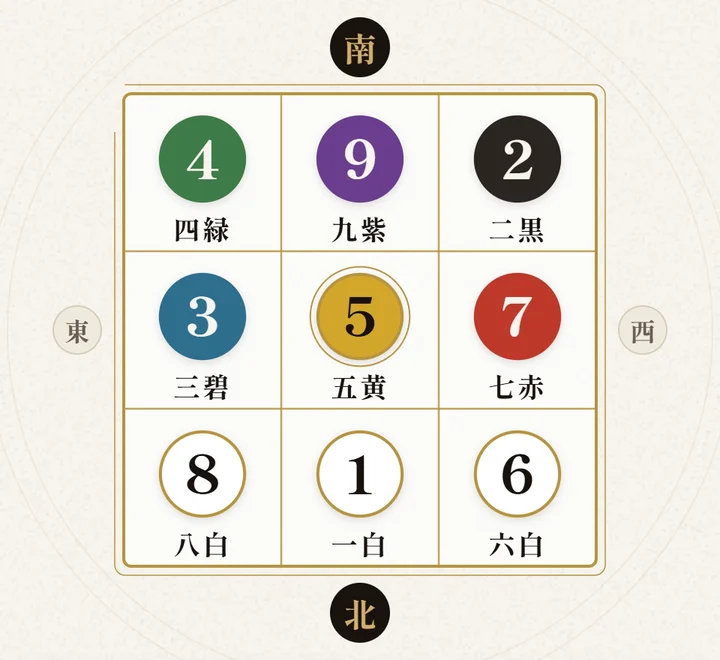
The board has directions: south at the top, north at the bottom
Unlike an ordinary map, the Nine Star Ki board has south at the top and north at the bottom (east on the left, west on the right). Drawing south at the top is the convention of old Chinese diagrams. The nine places correspond to the eight compass directions plus the centre.
| Number | Star | Home position (direction) |
|---|---|---|
| 1 | One White Water Star | North |
| 2 | Two Black Earth Star | Southwest |
| 3 | Three Jade Wood Star | East |
| 4 | Four Green Wood Star | Southeast |
| 5 | Five Yellow Earth Star | Centre |
| 6 | Six White Metal Star | Northwest |
| 7 | Seven Red Metal Star | West |
| 8 | Eight White Earth Star | Northeast |
| 9 | Nine Purple Fire Star | South |
The “Water, Earth, Wood, Metal, Fire” in each name is the star's element in Five-Element thought, which sorts things into five qualities.
04The stars simply move “one step each year, in number order”
Now the stars move. The Nine Star Ki board changes a little every year, but there is only one rule for how it changes: every star moves one place along, in the order of the place numbers. The order starts from place 5 in the centre and follows the places whose numbers go up one at a time.
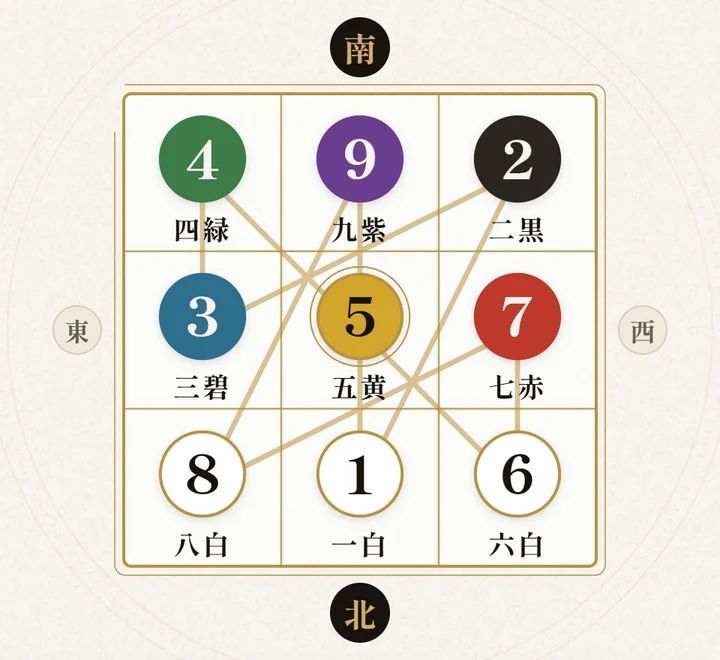
There are nine places, so after exactly nine years every star is back where it started. This is what Nine Star Ki calls the “nine-year cycle of fortune”.
This year's board: line the stars up from the centre
Because the stars move one step at a time, the star in the centre (place 5) changes every year, and its number goes down by one each year (after 1 comes 9). 2026 is called “the year of One White”; 2027 is “the year of Nine Purple”.
Centre star: 2026 = One White (1) → 2027 = Nine Purple (9) → 2028 = Eight White (8)
The 2026 board (from Risshun to the day before the next Risshun). The base board is the board of a year in which Five Yellow is placed in the centre in this way.
Your own star (Principal Star) can also be worked out from your year of birth
The star of the year you were born — your Principal Star — is the star that was in the centre of that year's board. Add up the digits of the year until you have a single digit, and subtract it from 11 (if the answer is 10 or more, subtract 9).
1985 → 1 + 9 + 8 + 5 = 23 → 2 + 3 = 5 → 11 − 5 = 6 (Six White Metal Star)
When the year goes up by one, the digit sum goes up by one and the answer goes down by one. That is exactly why the centre star goes down by one each year. Note that the Nine Star Ki year begins at Risshun (around 4 February), so anyone born between 1 January and the day before Risshun uses the previous year.
05How fortune (the biorhythm) is read
In Nine Star Ki, fortune is read from which square (palace) your own star — your Principal Star — is in this year.
The nine squares of the base board (the Koten Teii-ban) stay in place even as the stars move, and each square has a fixed character, rather like a season. The north square is winter, the northwest square is the autumn harvest, and so on. It is used as a guide in the form of “this is a sowing year, so try something new!” or “next year is a winter year, so put defence before attack”.
The character of the nine squares
| Square (palace) | Direction | As a season | Fortune score |
|---|---|---|---|
| Chugu | Centre | Summer — reaching the peak | 9 |
| Ken | Northwest | Autumn — the peak of the harvest | 10 |
| Da | West | Late autumn — enjoying the fruits | 8 |
| Gon | Northeast | Early winter — a turning point | 5 |
| Ri | South | Deepening winter — light and shadow part | 3 |
| Kan | North | Winter — the bottom (rest and gather strength) | 1 |
| Kon | Southwest | Before spring — preparation | 3 |
| Shin | East | Spring — getting started | 5 |
| Son | Southeast | Early summer — growing with a fair wind | 7 |
Listed in the order the stars travel (Chugu → Ken → … → Son). The fortune scores are the values used by the Nine Star Ki Fortune Calculator (10 is the highest), based on the view that Ken in the northwest — the peak of the harvest — is the top of the cycle. Where to put the peak is a point on which schools of Nine Star Ki differ.
In 2026, which star is in which square?
The “base board” and the “2026 board”. Compare the squares in the same position and you can see which square your star has moved into this year. The square's name and fortune score belong to the place, so they are the same on both boards. Only the stars have moved.
For example, people whose star is “Two Black Earth Star” are, in 2026, in “Six White's square” of the base board. Its character is “autumn, the harvest”. Someone who keeps this in mind can take it as a guide: “try new challenges up to 2025, and bring them to fruit in 2026”. Guides like this can be drawn out year by year, month by month and day by day.
2026 = from Risshun on 4 February 2026 to around 3 February 2027.
Over nine years, a wave that goes once round the seasons
The stars move one place along each year. So if you line up the fortune scores of the squares your star will enter, you get a wave that goes round once in nine years — a biorhythm.
06How old is the idea? From a board of 2,000 years ago to “Kigaku” in the Taisho era
This arrangement of numbers has been in use since ancient times. A Chinese legend says it was the pattern on the shell of a turtle that rose from the Luo River before Yu, the king who tamed the great floods. The name “Luo Shu” comes from the name of that river.
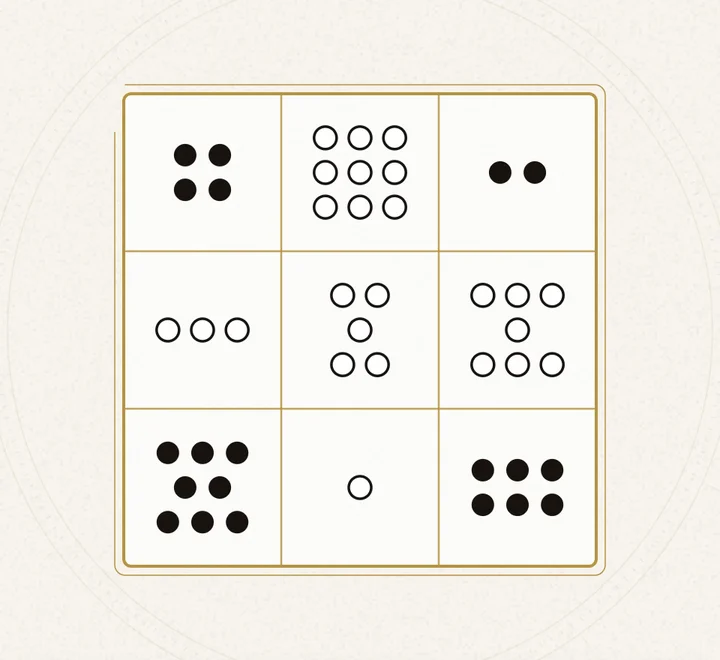
It is not only a legend. The same arrangement of numbers is carved on a divination board found in a tomb from China's Han dynasty, more than 2,000 years ago. Then, in Japan, in Taisho 13 (1924), Sonoda Shinjiro reorganised the older ideas about the nine stars and set them out as “Kigaku”. That is the basis of what is now called Nine Star Ki (Kyusei Kigaku).
- The age of legendSaid to be the pattern on the shell of a turtle from the Luo River
- Han dynasty (over 2,000 years ago)The same arrangement carved on a divination board
- Taisho 13 (1924)Sonoda Shinjiro sets it out as “Kigaku” in Japan
Which square is your star in this year?
Your Principal Star is fixed by your year of birth. Just enter your date of birth and it is calculated automatically, including the Risshun boundary. Free, no sign-up.
Calculators for compatibility, personality and lucky directions are available in Japanese: compatibility · personality · lucky directions.
Frequently asked questions
What is the origin of Nine Star Ki?
Which star is in the centre of the board this year?
How do I find my Principal Star?
About the author
Find your star
Just enter your date of birth to see this year's square and your nine-year wave of fortune. Free, no sign-up.